
Crash Barrier- The Main Features For Highways & Road Safety
Crash Barrier- The Main Features For Highways & Road Safety
Anyone who has driven along a busy national highway or a winding hill road has probably noticed those steel rails running along the edge, quietly doing their job while nobody pays them much attention. That is the crash barrier at work.
As India’s road network keeps expanding, choosing a dependable metal crash barrier manufacturer in India has become just as important as the quality of the tarmac itself. This blog looks at what a crash barrier actually does, the features that separate a good one from an average one, and what you should check before picking a supplier.
What Is A Crash Barrier And Why Does It Matter?
A crash barrier is a steel or galvanised structure fixed along the edge of a road, bridge or median to redirect a vehicle that veers off course, absorb the force of a collision and stop it from crossing into oncoming traffic or going over an embankment.
On hilly stretches, near water bodies or along elevated flyovers, this single feature can be the difference between a manageable accident and a fatal one. That is precisely why road safety authorities across India treat crash barriers as a mandatory part of highway construction rather than an optional extra.
What are the Main Features of a Good Crash Barrier?
A well-made crash barrier should cushion the impact of a collision, resist corrosion in India’s humid and monsoon-heavy climate, hold its shape under repeated stress and redirect a vehicle gradually instead of stopping it dead.
Galvanisation is worth paying attention to here. A barrier that is hot-dip galvanised holds up far better against rust than one with a basic paint coating, particularly on coastal highways or routes that see heavy rainfall for months at a stretch. Post spacing, beam thickness and mounting height also need to follow the specifications laid down by the road safety departments, since even a slightly undersized barrier can fail to do its job when it matters most.
What Types of Metal Crash Barriers are Used on Indian Highways?
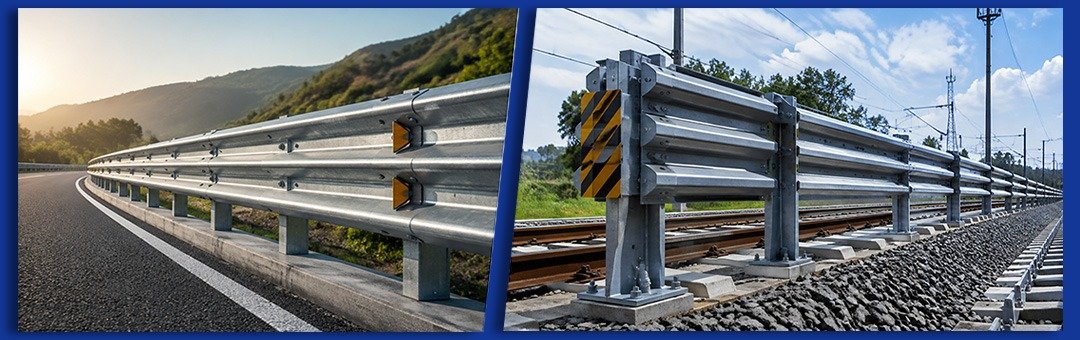
Two systems dominate Indian road projects: the W-Beam Metal Crash Barrier and the Thrie Beam Metal Crash Barrier, each available in single-side and double-side configurations depending on whether the barrier needs to protect traffic on one carriageway or both.
W-Beam barriers are the more familiar sight on national and state highways, while Thrie Beam systems, with their extra rib, are favoured on stretches that see heavier or faster traffic, such as bridges and race tracks. The right choice usually comes down to traffic density, vehicle speed and the terrain the road passes through.
How Do Crash Barriers Actually Improve Road Safety?
They reduce the severity of a crash by absorbing the vehicle’s momentum instead of letting it collide head-on with whatever lies beyond the road edge, whether that is a cliff, a gorge, oncoming traffic or a pedestrian area.
Beyond the obvious protection during a collision, barriers also lower repair costs by limiting damage to the vehicle, and they give drivers a visual cue about where the safe edge of the carriageway ends, which matters a great deal on unfamiliar hill roads at night.
What Should You Check Before Choosing A Metal Crash Barrier Manufacturer In India?
Look at manufacturing capacity, compliance with road safety norms, the quality of galvanisation on offer, a genuine track record on highway or bridge projects, and the ability to deliver on schedule for large infrastructure timelines.
A manufacturer that has actually supplied barriers for national highways or bridge projects will understand load calculations and installation requirements far better than one working purely on paper specifications. It is also worth asking how the barriers are tested and what certifications back up their claims, since road safety is not a place to take a supplier’s word at face value.
Why Choose Pinax Steel For Your Crash Barrier Requirement?
Pinax Steel brings over 25 years of experience in the steel industry to its crash barrier manufacturing, running from its facility in Patna, Bihar, and producing close to 48,000 MT of crash barriers annually, supplying both W-Beam and Thrie Beam systems across national highways, state highways, bridges and race tracks in India and abroad.
Backed by that steel industry experience, Pinax has built a reputation as a metal crash barrier manufacturer in India that road builders can plan around with confidence, not just for the quality of the steel, but for the reliability of the supply.
Whether you are working on a highway stretch, a bridge or an industrial road network, a crash barrier that is well designed and properly galvanised is not an expense; it is protection built into the road itself. Getting the specification and the supplier right the first time saves both cost and risk further down the line.