Hot Rolled Steel Products: Uses, Types and Key Benefits
Hot Rolled Steel Products: Uses, Types and Key Benefits
If you work in construction, fabrication or heavy engineering, you’ve likely worked with hot rolled products in India already, even if you’ve never called them that. They come in the form of coils, sheets, plates, angles and beams, and they’re behind a lot of the structural work happening across the country right now.
This blog breaks down what hot rolled steel actually is, the types you’ll come across and why it holds up so well on demanding, large-scale projects.
What Are Hot Rolled Steel Products?
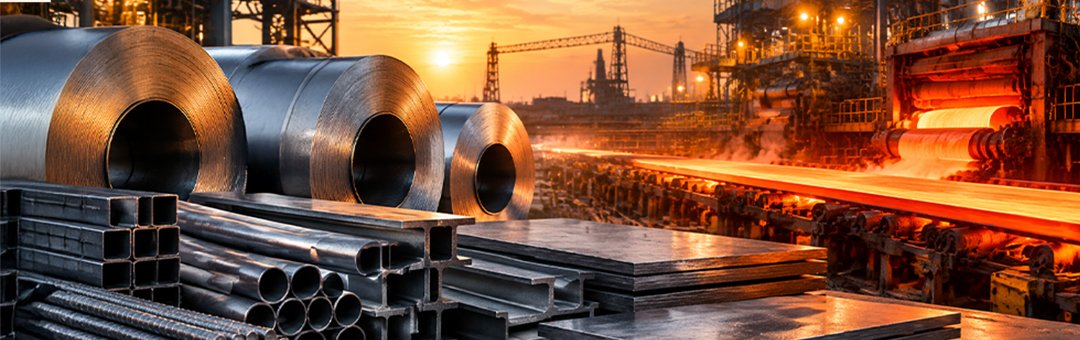
Hot rolled steel products are steel items shaped by heating steel above its recrystallisation temperature, usually well past 900°C, and then passing it through rollers while it’s still soft and pliable. This makes the steel easy to mould into coils, sheets, plates, angles and beams without cracking. Because the steel is worked while hot, it cools naturally afterwards, giving these products a slightly textured surface and looser dimensional tolerances compared with cold rolled steel.
How Is Hot Rolled Steel Actually Made?
Hot rolled steel is made by heating raw steel slabs or billets in a furnace until they turn soft, then rolling them repeatedly through progressively narrower rollers to reduce thickness and shape the metal into the desired form.
Since this entire process happens at a high temperature, there’s no need for the extra cold processing that adds cost elsewhere, which is exactly why hot rolled steel tends to be more budget-friendly than its cold rolled counterpart.
What Types of Hot Rolled Products Are Commonly Used in India?
The most commonly used hot rolled products in India are coils, sheets, plates, angles and beams, each suited to a different kind of job. Hot rolled coils are continuously rolled and wound up, making them ideal raw material for pipes, tubes and further fabrication work. Sheets are flat and thinner, favoured for general fabrication and equipment panelling.
Plates come in thicker gauges and are trusted for heavy structural work, pressure vessels and shipbuilding. Angles, with their L-shape, are widely used for structural framing and support brackets, while beams, particularly I-sections and H-sections, carry heavy loads in buildings and bridges. Many manufacturers, including Pinax Steel, also supply MS round, MS flat and MS angle sections built on the same hot rolling process.
Where Are Hot Rolled Steel Products Used?
Hot rolled steel products are used extensively across construction, heavy machinery manufacturing, railways and shipbuilding, largely because these industries need material that can handle serious structural loads. In construction, hot rolled sections form the skeleton of buildings, from columns and beams to reinforcement work.
Heavy machinery manufacturers rely on hot rolled plates and sections to build sturdy chassis and equipment frames that won’t warp under stress. Indian Railways uses hot rolled steel in coach bodies and undercarriage components, and shipbuilders favour hot rolled plates for hulls thanks to their strength and weldability. The automotive sector, too, depends on hot rolled coils for chassis parts and structural panelling.
What Are the Key Benefits of Hot Rolled Steel?
The biggest benefits of hot rolled steel are its strength, affordability and ease of fabrication, which together make it a practical first choice for demanding structural work. Because the process involves fewer finishing steps than cold rolling, hot rolled products in India are noticeably more cost-effective, which matters on large projects where volumes run high.
The high-temperature rolling also leaves the steel with lower internal stress, so it holds up well under load without warping. On top of that, hot rolled steel welds and machines easily, and it’s readily available in large sizes and thicknesses that would be difficult to achieve through cold rolling.
How Does Hot Rolled Steel Differ from Cold Rolled Steel?
Hot rolled steel differs from cold rolled steel mainly in how it’s processed and finished, with hot rolled steel worked at high temperature for a rougher surface and looser tolerances, while cold rolled steel is processed at room temperature for a smoother finish and tighter precision. This also affects cost, as cold rolling requires additional steps and commands a higher price.
As a general rule, hot rolled steel suits structural and heavy-duty applications where exact dimensions matter less than raw strength, while cold rolled steel is better reserved for precision components and visible finished parts.
Why Choose Pinax Steel for Hot Rolled Products in India?
Pinax Steel brings more than 25 years of experience in the steel industry, backed by over 50 certifications and a client base of more than 1,000 businesses across India. Our hot rolled coils, sheets, plates, angles and beams are manufactured at our facility in Patna, Bihar, using high-quality raw materials and rigorous quality checks at every stage. We offer a wide range of sizes, thicknesses and grades, along with customisation options, so you get material genuinely suited to your project rather than a one-size-fits-all product.
If you’re sourcing hot rolled products in India for your next project, our team is ready to help you find the right specification and grade for the job. Get in touch to discuss your requirements.